


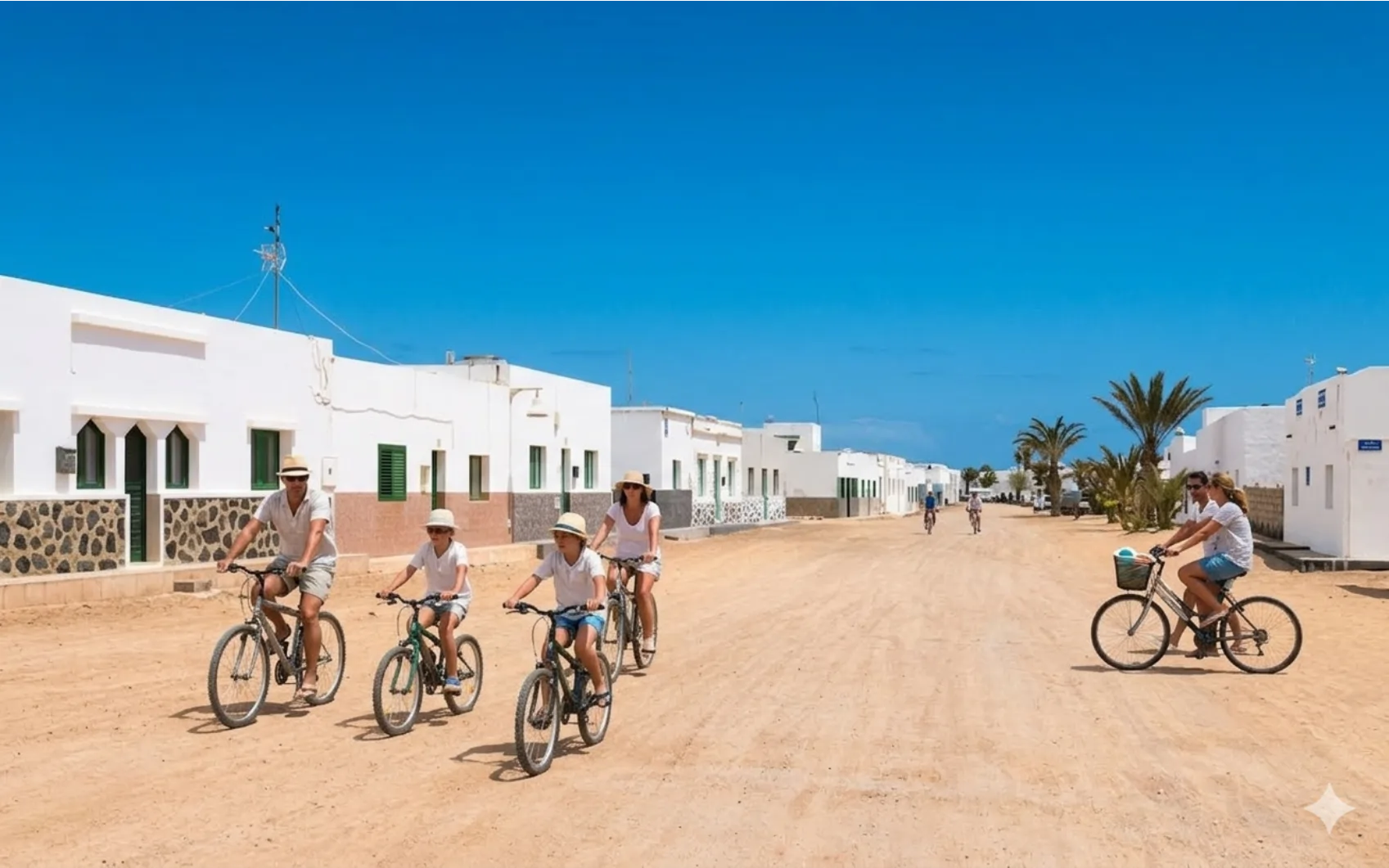
Caleta de Sebo is the only relevant urban centre in La Graciosa, the smallest inhabited island in the Canary archipelago. Situated off the north coast of Lanzarote, this quiet town has become a popular destination for travellers in search of unspoilt nature, spectacular beaches and a completely different pace of life to that of overcrowded tourist destinations.
With just a few sandy streets, white houses with traditional architecture and a small fishing port, Caleta de Sebo retains the charm of the fishing villages of yesteryear. This small enclave is also the administrative, social and tourist heart of the island, from where excursions, bicycle routes, 4×4 taxis and visits to some of the most impressive beaches of the Canary Islands depart.
In this comprehensive guide you will discover what to see in Caleta de Sebo, how to get there, what to do and why this small village is the soul of La Graciosa..

What is Caleta de Sebo
Caleta de Sebo is the capital of La Graciosa, The island belongs to the municipality of Teguise (Lanzarote). It is located within the Chinijo Archipelago Natural Park, one of the most important protected natural areas in the Canary Islands.
This village is the place where the ferries arrive from the port of Órzola, in Lanzarote, where practically all the island's services are concentrated:
- accommodation
- restaurants
- supermarkets
- Bicycle rental
- taxis
- excursions in La Graciosa
The town has a population of approximately 700 inhabitants, This makes it one of the smallest capitals in Europe.
However, their importance goes far beyond their size: Caleta de Sebo is the nerve centre of La Graciosa and the starting point for exploring the whole island..
Where Caleta de Sebo is located
Caleta de Sebo is located on the east coast of La Graciosa., off the island of Lanzarote and very close to the strait known as the The River.
Some of the most spectacular landscapes of the Canary Islands can be seen from its port:
- the Riscos de Famara in Lanzarote
- the islet of Clear Mountain
- the small islet Roque del Oeste
This unique natural environment makes Caleta de Sebo a privileged place to enjoy the sea, tranquillity and nature.

How to get to Caleta de Sebo
Reaching Caleta de Sebo is simple, although it requires a short boat trip.
Ferry from Lanzarote
The only access to La Graciosa is by sea. Ferries depart from Órzola, in the north of Lanzarote.
Journey data:
- duration: approximately 25 minutes
- frequency: several trips per day
- destination: Caleta de Sebo Port
Once the boat arrives in the harbour, visitors disembark directly in the heart of the village.
Transport on the island
At Caleta de Sebo There are no paved roads and no heavy traffic. Travel within the island is mainly by road:
- bicycles
- 4×4 taxis
- hikes
This style of mobility contributes to preserving the natural and peaceful character of the place.

History of Caleta de Sebo
Today, however, it is the centre of life in La Graciosa, Caleta de Sebo has not always been a permanently inhabited place..
For centuries, the island was mainly used by fishermen from Lanzarote who came to its coasts to take advantage of the richness of the sea.
It was not until late 19th and early 20th century when the first settlers began to establish themselves on a stable basis. The families were mainly engaged in:
- fishing
- salting of fish
- small agricultural activities
Over time, the village slowly grew to become the main settlement on the island.
Despite recent tourism development, Caleta de Sebo continues to maintain its seafaring essence and its leisurely pace of life..
What to see in Caleta de Sebo
Although it is a small town, Caleta de Sebo offers several interesting places that are worth a visit.
The port of Caleta de Sebo
The port is the heart of the village.
This is where the ferries arrive and where many of the sea-related activities are concentrated:
- La Graciosa excursions by boat
- fishing
- sea taxis
- transport of goods
Strolling along the harbour at sunset is one of the most pleasant experiences you can have in La Graciosa.

Salado Beach
Very close to the port is Salado Beach, A small beach with golden sand and calm waters.
It is ideal for:
- take a quick bath
- relaxing after arriving by ferry
- enjoy the scenery
From this beach you can enjoy spectacular views of the Riscos de Famara.
Church of Nuestra Señora del Carmen
The small church of El Carmen is one of the most emblematic buildings in Caleta de Sebo.
Every year, during the Carmen festivities, a maritime procession is held, which is very popular among the island's inhabitants.
The sandy streets
One of the most characteristic features of Caleta de Sebo is that many of its streets are still made of sand.
This detail reinforces the natural and peaceful character of the village, and makes it a place unlike any other tourist destination in the Canary Islands.
What to do in Caleta de Sebo
As well as strolling through the village, Caleta de Sebo is the starting point for many activities in La Graciosa..
Excursions around the island
From the village there are routes to some of the most spectacular places on La Graciosa:
- Las Conchas Beach
- French Beach
- Yellow Mountain
- Pedro Barba
These excursions can be made:
- by bicycle
- by 4×4 taxi
- walking

Taxi tours of La Graciosa
One of the most convenient ways to get to know the island is by means of the 4×4 taxi tours.
These tours allow you to visit the main beaches and landscapes of La Graciosa in just a few hours, with local guides who know the area perfectly.
Local gastronomy
At Caleta de Sebo you will find several restaurants where you can enjoy the typical Canarian gastronomy.
Among the most popular dishes are:
- fresh fish
- wrinkled potatoes with mojo
- octopus
- squid
- goat's cheese
Many restaurants have terraces overlooking the sea.
Caleta de Sebo and sustainable tourism
One of the aspects that make Caleta de Sebo is its commitment to a sustainable tourism model.
The island has limited urban development and maintains rules aimed at preserving the natural environment.
Among the most important measures are:
- traffic control
- infrastructure constraint
- protection of the Natural Park of the Chinijo Archipelago
Thanks to these policies, La Graciosa remains one of the most authentic and least altered places in the Canary Islands..

When to visit Caleta de Sebo
Caleta de Sebo can be visited all year round., The climate of the Canary Islands is mild and pleasant.
Average temperatures:
- winter: 18-22°C
- summer: 24-28°C
The best months to enjoy the island tend to be:
- April
- May
- September
- October
During these periods there are fewer visitors and the weather remains excellent.
Tips for visiting Caleta de Sebo
If you are planning to visit Caleta de Sebo, If you do not have a clear idea of what to do, there are a few tips to keep in mind:
- wear sunscreen
- carry water if you do long routes
- book excursions in advance
- respecting the natural environment
It is also advisable to stay at least one night on the island to enjoy the peace and quiet when day-trip visitors leave.
Why Caleta de Sebo is one of the most special places in the Canary Islands
Unlike other tourist destinations, Caleta de Sebo maintains an authenticity that is hard to find nowadays..
There are no big hotels or massive resorts here. Instead you will find:
- intact nature
- wild beaches
- silence
- local hospitality
This combination leads many travellers to consider La Graciosa and its capital Caleta de Sebo as one of the last paradises of the Canary archipelago..

Discover Caleta de Sebo and the essence of La Graciosa
Visit Caleta de Sebo is to discover a place where time seems to stand still. Its sandy streets, its small harbour and its unique natural environment make this village the perfect starting point to explore La Graciosa.
Whether for enjoying its beaches, Explore La Graciosa by bike or simply contemplating the ocean from the harbour, Caleta de Sebo offers an authentic experience that is hard to find in other tourist destinations..
If you are looking for nature, tranquillity and unforgettable landscapes, Caleta de Sebo awaits you in the heart of La Graciosa.